
To make mistakes is human; to stumble is commonplace; to be able to laugh at yourself is maturity.
William Arthur Ward
This is a true story.
My office phone rings.
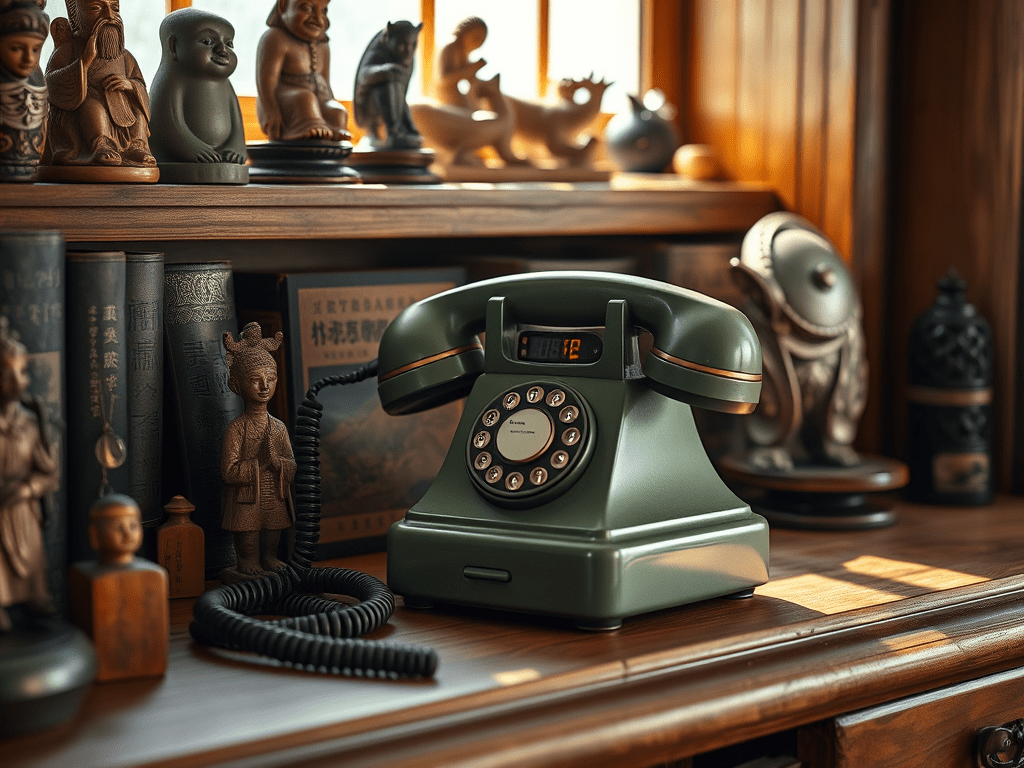
For the record, and to ensure that you conjure up the correct image, the phone is no digital, touch-dial, hands-free masterpiece: it is a dial-up, analogue, antique monolith – a greenish-grey color, and heavy. It rings. It cannot beep, tweet, sing or dance. It can ring. And only ring. It cannot interact with a call center’s artificial intelligence: push 3 for international reservations… 9 for an operator… please wait, all operators are busy at this time, you are the 247th caller… your conversation may be recorded – no, it cannot. It is a telephone designed to link humans in conversation. Period! Pure and simple! It is an Alexander Graham Bell masterpiece; the first technology that sort to kill the art of conversation by connecting people across vast distances.
This antique masterpiece now sits on the bookshelf in my new office alongside the Three Monkeys, some Ainu carvings, and a few other trinkets, reminders of the context I choose to call my second home: Japan.
“moshi moshi” (hello) I answer.
“I am really sorry to bother you with this telephone call. Can I come and talk to you?”
“Yes. Is there a problem about my travel?” (A-san, the interlocutor on the other end of the telephone usually only braves initiating a call or a chat to me if it relates to travel or to kindly give me my pay slip.)
“Kind of…”
Several minutes pass and then a reticent knock knock on the door arrives.
“hai, dozo. (Come in.) What’s up?” I ask with a wry grin.
A-san sheepishly looks at me, then back to the linoleum floor. “XYZ-san…” (all persons herein called san are from ‘the office’. I am otherwise; donned with a prestigious sensei title. I will designate an alphabetical naming to keep the persons as anonymous as possible.) “XYZ-san wants the original receipt and ticket from your recent research-related travel.”
“I have submitted them already with my inkan (Japanese signature stamp) dutifully stamped to certify that they were mine.”
A-san shows me a photocopy of the ones I submitted with my red inkan mark clearly visible above my name printed on each document. “But, XYZ-san wants the originals.”
I try not to look surprised. “The ones I submitted were the original official download from the Japan Airlines web page. It is called an e-ticket. And, the receipt is prepared as a pdf file directly from the JAL web page. These are JAL’s official receipt and e-ticket.”
I am confidently refuted: “But XYZ-san wants the originals.”
“They were the originals” I interject. “Look! Here is a pdf copy” showing a copy that I had saved to my computer. “It is not a doc file, nor an xls file, nor a pptx file. It is not even a jpeg or mpeg, nor gif or html. It is pdf! An e-ticket means – it is an electronic version of the ticket! That means it is generated from the Internet to a computer or to a tablet computer, like an iPad.” I lift the iPad off the desk to show him.
… “But XYZ-san wants the original.”
By now, I am sure you can appreciate that I was starting to feel a little… the word starting with f… frustrated. I start to wonder whether I should take my iPad down to XYZ-san and show him the original digital file. “Would he like to keep the iPad as the original?” I wanted to ask.
“Where does XYZ-san live?” I continue noticeably annoyed. “In what Century? It is an e – for electronic, as a is for apple and b is banana and c is for can you believe this? – e — ticket. I have submitted the original downloaded pdf versions to the office.”
“But XYZ-san wants…”
….
These older bureaucratic gentlemen run much of the country.
I am living in Japan, one of the most developed and technically advanced countries on our planet! It ranked first in a British index for future reputation because of the reliability of its products and services, healthy eating, natural beauty… and high technology and innovation. I have been living here for more than half my life. In fact, I have lived in Japan as long as I have lived in Australia – the country that issued me with that electronically coded passport that could have caused me much more grief had my visa stamp offer been taken at face value. Richard Branson once said that he was a “big believer in the power of language to change the world. The way we communicate, whether verbally, digitally or physically, has a massive effect on how we work, live and learn…” No more does this hold true than in Japan.
Japan is postcard perfect. Ancient shrines and temples, hues of red and gold, oak and cedar, covered by shades of slate, entice our meditative, religious, ancient superstitions. Villages, serene, dotted with grass-thatched roof houses blanketed in layers of snow – perfect pillows upon which to dream our fantasies of histories past. Pastel cherry blossom pinks, ruby red lips, powder-caked white faces, tightly wrapped in layers of silk disguising the contours within, waddle in choreographed steps in nature cherished, balanced against a setting of an era long since gone – the maiko, geiko, kabuki and noh, and merchants who keep the cultural dress-code a necessity for the formal events: Coming of Age, weddings, graduation. Fuji-san, cultural icon, watches ever over the sacred land, with illusory power, rises massively on the Kanto horizon. Moss-drenched temperate forests, alpine peaks, tropical beaches and coral reefs, azure blue mystical lakes, cascading waterfalls, hot sand surrounding frigid lakes and volcanic water springs cooled to soaking perfection in rock pools along alpine streams, rolling golden sand dunes, lavender carpeted purple hills, morph into waves of snow toward mountainous horizons. Monkeys soaking in hot springs to absorb the heat in frigid winter temperatures, or washing potatoes in ocean water to add a zest of salt to their treat. Japan: the postcard photo to be found in the Rising Sun.
Equally stimulating are the neon lights of techno-towns, nightspots to suit your pleasure – at a cost. Avant guard fashions, Ginza, Harajuku, Maid or cat cafes, anime fetish, entertainment services, exuberances of politeness, androgyny to your political-correctness pleasure, practices in perfecting kawaii-ness (cute) sexuality, business drinking parties, sardine-packed transportation in urban jungles, self-opening taxi doors, electronic gadgets and devices to meet your every need, convenience stores that actually are convenient, book stores where you can stand all day reading without being asked to buy the publication you just picked up to examine the table of contents.
Cleanliness – clean streets, clean trains, clean buses, clean seats, clean vending machines, clean walls on train lines, clean parks, clean public spaces, and if you still have not understood, a very low chance you will end up with chewing gum on your shoe or trousers because it is clean. The public toilets are (mostly) clean – unless you get unlucky and encounter one of the Asian squatting types at which point the statistical possibility of it not being clean rises quite dramatically – except at the convenience stores, which are really convenient (in case you missed that). Even the air in the metropolis Tokyo is clean – well, relatively, until the smog from China is caught up in the wind and dumps itself all over Japan – and my car!
Japan, a country that has perfected the finesse (a very important thing to understand about Japan and one I will return to time and time again) of proudly telling the world how great it is; how uniquely different it is to every other culture; how special the Japanese people are due to their agrarian history and not the carnivorous meat-eating savagery of those others – and how their genetic coding is different which makes their culture different. There are myriad – almost ubiquitous – examples on the proliferous creativity that abounds in Japan, leading the prime minister to develop the very creatively misleading ‘Cool Japan’ campaign. Thought is consumed by the amazingly 美味しい (delicious) culinary delights, especially when a talento (so-called and self-donned titles of television personalities, many of whom are neither talented nor have personalities worth discussing) proclaim a dish to be heavenly, and therefore must truly be from the gods.
Japan: the country with the fabled Bullet Train (shinkansen) that zips conveniently between major cities, from Fukuoka in Kyushu in the south, to Hakodate in Hokkaido in the north, and west to the Japan Sea, passing though beautiful rural scenes: golden rice fields in autumn, snow covered peaks in winter, pink cherry trees in blossom in Spring dotting many roads and paths, and over hues of green in the summer haze. The shinkansen, a poorly disguised monopoly created by dissecting Japan Rail into different entities, is clean, efficient, quiet, comfortable, and the cleaning staff that service the trains set the global standard! The only real challenge to the shinkansen’s dominance is the airline industry. Up until recently, with the arrival of the Low Cost Carrier airlines (LCC), and the upgrading of Tokyo International Airport at Haneda, travel between Tokyo and Kyoto-Osaka, or Osaka and Hiroshima and Fukuoka, airlines were not a serious viable alternative. As with many things in the over-sold efficient Japan, the disguised monopoly is not quite as smooth as it seems.
….
A coin does not have only one side. Although it is statistically possible to flip a coin and have it land on the same side over and over and over again, life does not usually follow such probabilities. On occasions when a coin lands on heads more often than we are comfortable with, we cry foul. It is possible for a coin to be flipped 100 times and have it land on the same side 100 times, but we feel uncomfortable. The result does not match our patterns of the world. We believe something is not what it seems: is it a two-headed coin? Is it weighted? And so too should we be suspicious when Japan (or any culture, institution, organization or individual) continually shows only one side of the coin. That is not life. Moreover, and for me, more importantly, if we only see one side of a coin we fail to grasp the fullness and completeness and essence of any creation or phenomena. I love my wife not because she is perfect, but because she is a beautiful creation that is made whole in her sweet magnificence and annoying irritations. If there was no darkness we would not appreciate the light. If strawberry were the only fruit then we would be lesser for not having savored nashi, Yamagata cherry, Aomori apples or sweet mikan. We would equally fail to appreciate the strawberry if we have never tasted a sour plum or the strong-scented durian.
For all of the exotic and delightful truths that enchant and bewitch us in Japan, there is a catch: they equally have a hidden face. These hidden faces or untruths make Japan the paradox that betwixt the unsuspecting. Japan has perfected finesse, and this finesse provides the first and most important thing to know about the other side of the Japan coin: tatemae. The tatemae, the façade, the way things look is the primary, no-compromise, important variable that permeates every thought, act, deed, design, spoken word, service, kindness, friendship, relationship, taboo, visit to the doctor, graduation from university, or sound emanating from the toilet. Everything is filtered through the how it will look or be perceived lens.
….
Purchase the book when it comes out.
 Malcolm's Home