
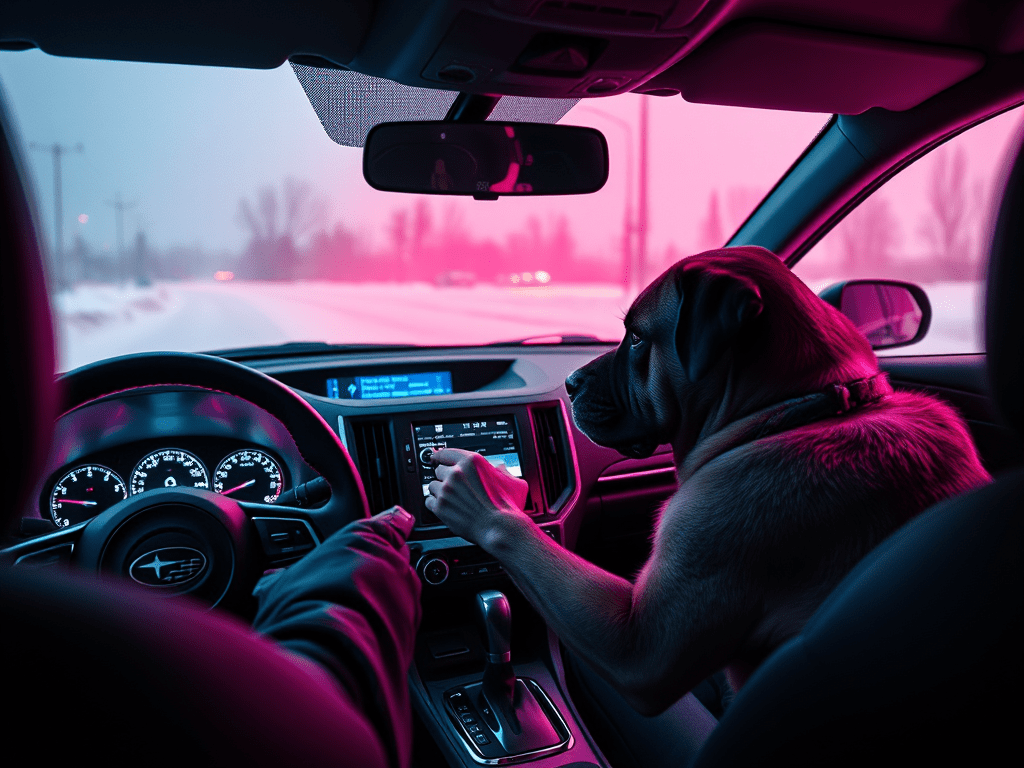
We have loaded the dog, and are seated in the front of the Subaru ready to depart for a quick trip to the vet – a very quick as it happened . The dog’s two small lumps have changed shape and grown over the past few months – quite rapidly, to me at least – so I suggested we needed to get it checked earlier on the odd chance it is not benign. The vet is usually busy so we decided to go later in the day; my mood was not helping, either.
It has been snowing a lot recently, and mostly grey overcast skies dominate. This morning, a rare appearance of blue increased the glare but soothed the sun-starved mind. I place my foot on the brake pedal, push the start button, turn the engine on, and warm the chilled car.
My wife, God bless her, reaches over, puts her hand through the steering wheel and states “turn the lights to automatic as we don’t need lights on now as I can see” as she turns the switch to automatic.
Now, mind you, I admit, I am a bit put out by the “driver in the passenger seat” making such an executive decision for me (confidence bias or arrogance – I must say I am the better driver of the two of us). But, her statement comes on the back of something that has really been “getting up my nose” in a big way lately, something that simply boils down to people living only in their own circle of concern without the slightest thought for others. This is becoming (or has become) a global phenomena; examples are easily recognizable on any day in any media, from “king hit” violence to gun ownership debates to not waiting in a line for other passengers to alight before getting on a train to POTUS making decisions that facilitate the killing of others in lands far away. Over the holiday period, this ‘bubble’ phenomena has been further brought to my pattern recognition by the seemingly complete lack of understanding by many drivers as to why their vehicles have headlights.
It is winter, so I usually leave for the morning walk with the dog between 6.30 and 7.00 a.m. – about an hour later than the summer months. In the evening, it is an hour or two earlier, leaving between 3.30 and 4.00 p.m. rather than around 6pm. In winter, at these times, even on a clear day, the light is still developing (or fading quickly) making visibility an overconfidence game for fools: we believe we can see clearly, but fail to realize that others may not be able see us as clearly as the fool thinks they can see.
In Europe and Australia it is a quite common practice to drive with lights on – especially on a highway on a sunny day – but also as soon as it starts to get grey, such as when it is overcast or inclement weather. Turning the vehicle’s lights on is not to help the driver see the road better at such times – that is quite meaningless – but is done so other drivers (and pedestrians and cyclists and hopefully dogs and cats and kangaroos) will be better able to notice you. (This is what the driverless cars have yet to figure out, and nor have those automatic light switches! useful only for when it gets dark and one forgets to switch the lights on. Has anyone else recognized the correlation between the decline in driver skill and the rise of technology – and automatic transmissions? Technology seems to be facilitating poor habits – and, forgetfulness.)
On my walks, I am amazed and bewildered by the number of cars that are dark colored, white colored, grey colored, and colored with stripes that blissfully drive about without their lights on, and without the slightest concern that they may not be easily seen by others. I once demonstrated the difference between vehicles with their headlights on and those without by asking my daughter which she could see first and furtherest and most easily. Of course, it was rhetorical. But it did provide an applied experiment, something I wonder whether car engineers and designers ever do beyond their wind tunnels and testing tracks.
My eyes are not bad; nor are they 20-20, but I have had to catch myself several times at early dawn and dusk when about to cross the street as a car has suddenly appeared (without lights).
A graduate student of mine was stopped by a policeman on a bicycle when she was riding her bicycle at about 5pm en route to our class. To cut short detailing the comedy that ensued with that event, I will raise the issue only to highlight that the policeman stopped her because she did not have her light on. I will not focus on the ninety-plus percent of Japanese gendarmes that would not stop a car for a similar offense, but only on the student’s reaction, which reflects the norm.
My student remarked quite adamantly “But I could see so why did I need to use my light?” I replied: “It is so other people, especially aged people, around the hospital area, can see you!”
Did she change her ways? Unlikely.
In Japanese there are two words that can mean safe: anzen and anshin. Anzen refers to being safe and anshin to the feeling of being safe. When a driver does not use lights in winter, on snowy or rainy days, at dawn or dusk, they are usually operating in their anshin; but they are not anzen. The same is often noticed with seat belts: a parent or driver is strapped in but the child remains unharnessed – I won’t get started. What can be said with confidence is that such practices result from operating only within one’s own circle of concern.
All of us try to live and understand the world by pattern recognition. And the more we recognize and accept these ‘patterns’, they become normalized. These norms can become fossilized, making them very hard to change. The patterns stabilize our existence and deviations to the patterns we have accepted as ‘norms’ or ‘natural state of affairs’ are both assets, such as conserving energy, and liabilities, by making it difficult accepting other ‘norms’ and ‘natural states’ exist elsewhere. This discussion is worthy of another post, which must also include the DK effect, WEIRD and NIMBY. However, the same mechanism is at work with headlights and seatbelts and indicators and…
When my wife reached through the steering wheel whilst I was driving to turn the lights to automatic from the “on” position and said “we don’t need lights now as I can see” I (no doubt) reacted quite badly. I drew on my defensive patterns of ‘rightness’, challenged what she said and explained – well, tried to – that her thinking was exactly the problem I had been discussing with her about car lights nearly every morning for the past three years after returning from my walk with the dog. “It doesn’t matter whether you can see but it helps others to notice you” I iterated.
A battle ensued with neither side willing to retreat. Our own patterns were indeed correct.
Yes, it was sunny and bright and headlights to see the road ahead were not needed. However, limiting the circle of concern in such contexts is faulty. Firstly, bright or otherwise, lights help other drivers, pedestrians and cyclists (and dogs and cats and kangaroos) see you more easily – as I demonstrated with my daughter. This is no less so on bright, winter days with snow and ice abounding on roads and footpaths. Secondly, a failure to admit fault that her thought was only in her circle of concern – as a passenger no less – bothered me. (My wife is a therapist so I guess I am even more sensitive about walking the walk if talking the talk.) So did the same “does not compute” moment experienced with my Grad student, and no doubt does not with the minions who don’t appreciate the value of using lights. Thirdly, related to the emotional button that was pressed no doubt, that my wonderful wife found no fault in her actions when she reached across to make an executive decision about how I should drive without giving it a second thought (something I might be guilty of when talking to students) was both arrogant, dangerous and unnecessary.
My wife is the most wonderful person. This personal story drove (pun intended) me to write about the use of – or lack thereof – car lights reflects the tendency for us to exist only within our very small circle of concern, at the expense of others. We fossilize our patterns of thinking through practice. Our inability or choice not to think beyond our circle of concern may be different from context to context (physical violence against women in Australia, guns in the USA, etc), but they are common to all humans. But some societies (and it seems the bigger the gun or the more money the society or individual has, the more binary they become in their ‘rightness’) believe they are above such selfish survival techniques: they are deluded and deceived. I, too, may be blind to my own patterns and constraints within my circles of concern, but at least I try to consider the bigger picture. And that is what we should all do. Even just a little.
(p.s. I was concerned as a visitor to Japan that I might be applying my driving standards and therefore my thoughts were misplaced. So, I checked with my neighbor who worked (now retired) at a driving license school. He assured me that drivers are taught to drive with the “day lights” switched on. “They forget” he said. I noticed he conveniently did, as well.)
 Malcolm's Home